
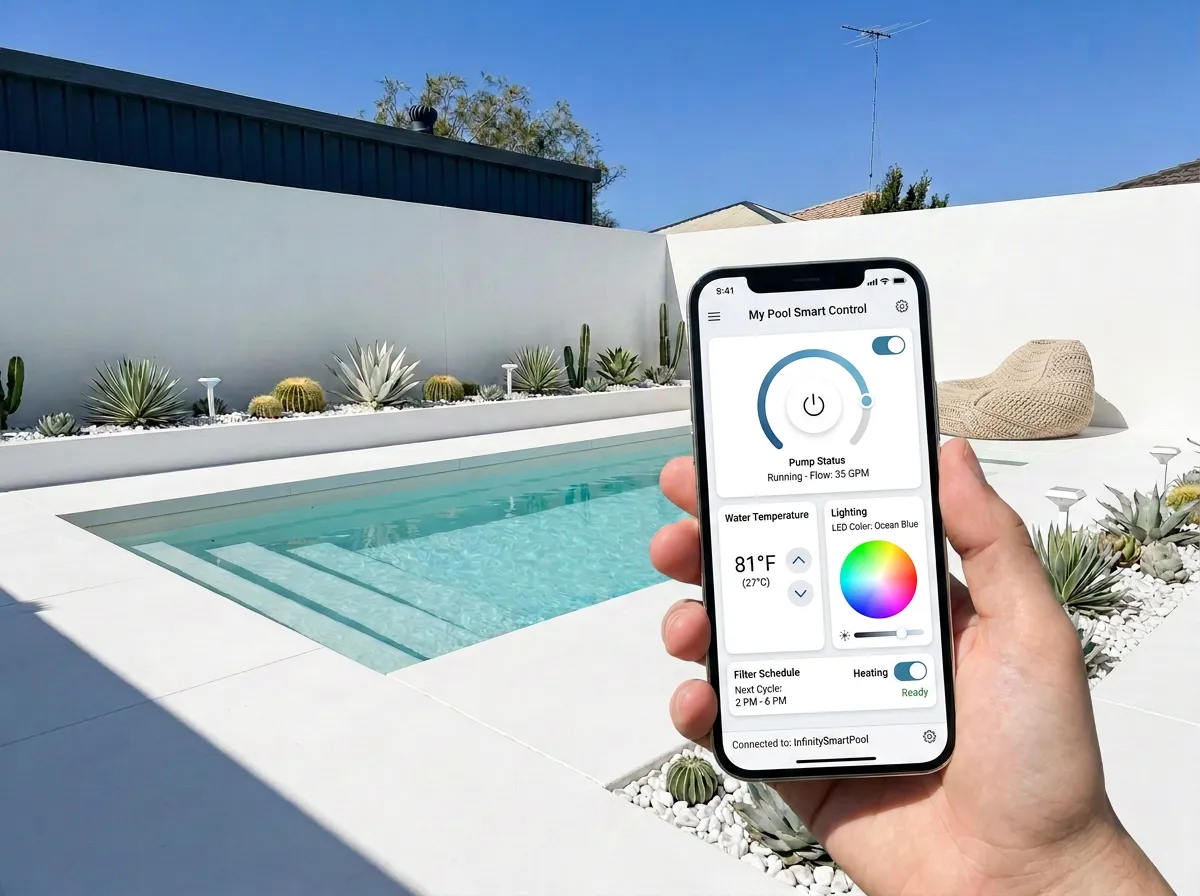
A few years ago, “checking on your pool” meant physically walking outside, looking at the water, and maybe sticking a test strip in. Today, a growing number of pool owners manage their entire pool – pumps, lighting, heating, and water chemistry monitoring – from an app on their phone, whether they’re in the next room or interstate.
For pool owners in the sunnier States, where pools tend to be used year-round and weather conditions can change quickly, smart automation offers some genuinely practical benefits beyond the convenience factor.
At its core, pool automation connects your pool’s equipment – the pump, filtration system, lighting, heating, and sometimes chlorinator or chemical dosing systems – to a central control unit that can be operated via an app, a wall-mounted touchscreen, or both. Instead of manually switching equipment on and off or adjusting settings at the equipment itself, everything is controlled digitally, and often automatically based on schedules or sensor readings.

Year-round pool use means year-round management. In regions with a shorter swimming season, pool automation is sometimes seen as a “nice to have.” In the sunnier States, where pools are often used for most of the year, having convenient control over heating, filtration scheduling, and lighting has a more consistent, ongoing benefit.
Weather can change quickly. Storm season can bring sudden heavy rainfall, which affects water chemistry and can introduce debris quickly. Being able to check water chemistry alerts remotely, and adjust filtration run-times in response, means you can stay ahead of issues rather than discovering them days later.
Remote monitoring suits holiday homes and rentals. For pool owners with a holiday property, or those who travel frequently, remote monitoring means you can keep an eye on the pool’s status without relying on someone physically checking it – and can respond quickly if something needs attention before your next visit.
Energy efficiency. Being able to fine-tune pump schedules and heating based on actual usage patterns – rather than running on a fixed, conservative schedule “just in case” – can help manage running costs, particularly relevant in warmer climates which means pumps and heating may run more often than in cooler states.
If you’re installing a new pool, automation-ready equipment can often be specified from the outset, making integration straightforward. For existing pools, many automation systems can be retrofitted to compatible equipment – though the level of functionality available depends on what equipment is already in place. If automation is a priority, it’s worth discussing compatible equipment options at the time of your initial pool consultation, even if you don’t plan to add the smart controls immediately.
If you’re considering adding automation to your pool, a few things worth asking about:

Interested in a smart-ready setup for your new pool, or want to know what’s possible for retrofitting? Get in touch and we’ll talk through your options.
Yes – with a compatible automation system, pool pumps (including variable-speed models) can typically be controlled, scheduled, and adjusted remotely via an app.
Many pool owners find it particularly useful in warm climates given year-round pool use. Other factors such as the potential for sudden weather changes affecting water chemistry, and the convenience for holiday homes or frequent travellers make the upfront investment worthwhile.
In many cases, yes – though the available functionality depends on the existing equipment. It’s worth checking compatibility with your current pump, heating, and lighting setup.
It can, by allowing more precise control over pump run-times and heating based on actual usage rather than fixed conservative schedules – though actual savings depend on your specific setup and usage patterns.
Many systems include water chemistry sensors that monitor pH and chlorine levels, sending alerts if readings move outside the expected range – useful for catching issues early, particularly after heavy rain.