
Your fibreglass pool needs the right filter to stay clean, safe and sparkling all year round. With so many pool filter options available, it can be difficult to know which system will work best for your backyard, your budget and the way you use your pool. Each filter type has its own strengths and drawbacks. Some are simple and cost-effective, some offer excellent water clarity, while others are better suited to busy families or pools that see heavy use during summer. In this guide, we compare five common pool filter options for fibreglass pools, including cartridge filters, sand filters, glass media filters, diatomaceous earth filters and combination filter systems, so you can make a more informed decision.
Key Takeaways
- The right pool filter helps keep your fibreglass pool clean, clear and easier to maintain.
- Cartridge filters are compact, simple to clean and do not require backwashing, making them a water-saving option.
- Sand filters are durable, affordable and easy to use, but may not capture the finest particles.
- Glass media filters are a modern upgrade to sand filters and can provide better water clarity with less frequent backwashing.
- DE filters can deliver very fine filtration, but they usually require more careful handling and maintenance.
- Combination filter systems can be a good option for busy households or pools with heavy use.
- The best pool filter depends on your pool size, usage, maintenance preferences, water clarity expectations and budget.
Choosing the Right Filter for Your Fibreglass Pool
Every pool is different, and so are the needs of pool owners. The right filter does more than keep your water looking clear. It also helps maintain a healthier swimming environment, supports your pool sanitation system and reduces the amount of dirt, oils, leaves and debris circulating through the water.
Choosing the right filter now can save you time, water and maintenance effort later. A filter that is too small or poorly suited to your pool may struggle to keep up, while the right system can make day-to-day pool care much easier.
Before choosing a pool filter, consider:
- How large your pool is
- How often the pool is used
- Whether the pool is used by children, guests or pets
- How much time you want to spend on maintenance
- How important crystal-clear water is to you
- How much water you are comfortable using for cleaning or backwashing
- Your upfront budget and long-term maintenance costs
What Do Microns Mean in Pool Filtration?
When comparing pool filters, you may see filtration performance described in microns. A micron is short for micrometre, which is one-millionth of a metre. In simple terms, microns are used to describe the size of the particles a filter can capture.
The lower the micron rating, the smaller the particles the filter can remove from the water. For example, a single strand of human hair is roughly 50 microns wide. Some filters only capture larger particles, while others can remove much finer debris.
It is important to remember that filtration is only one part of pool water care. Your pool filter helps remove physical contaminants, but proper pool sanitation and water balancing are still essential for keeping the water safe and healthy.
Pool Filter Options Compared
| Filter Type | Best For | Main Benefit | Main Drawback |
|---|---|---|---|
| Cartridge filter | Small to medium pools and low-maintenance owners. | No backwashing and easy cleaning. | Cartridges need regular cleaning and eventual replacement. |
| Sand filter | Medium to large pools and simple maintenance. | Durable, affordable and easy to use. | May not capture very fine particles. |
| Glass media filter | Pool owners wanting better clarity than sand. | Improved filtration and less frequent backwashing. | Higher initial setup cost than sand. |
| DE filter | Pool owners wanting very fine filtration. | Excellent water clarity. | More hands-on maintenance and careful powder handling. |
| Combination filter system | Busy families and heavily used pools. | Strong filtration performance across different particle sizes. | Can cost more upfront. |
Cartridge Pool Filters
Cartridge filters are a popular choice for fibreglass pools because they are simple, compact and effective. Instead of using sand or glass media, they use a pleated cartridge element to trap dirt, oils and debris as water passes through the filter.
One of the biggest advantages of cartridge filters is that they do not require backwashing. This means they can save water compared to systems that need to be flushed out regularly. Cleaning usually involves removing the cartridge, rinsing it with a hose and reinstalling it.
Cartridge filters are also useful for pool owners who want straightforward maintenance without too many complicated steps. Their compact design makes them a good fit for backyards where the pool equipment area is limited.
Benefits of Cartridge Pool Filters
- Simple and easy to use
- Compact design, making them suitable for smaller equipment areas
- No backwashing required, which helps reduce water waste
- Can provide very good water clarity
- Often perform well at lower pump speeds
- Easy to clean once you are familiar with the process
Things to Consider
Cartridge filters need regular upkeep. The cartridge must be removed and cleaned, and over time it will need to be replaced. Cartridge lifespan depends on pool usage, water chemistry and maintenance habits, but replacement is usually part of the ongoing cost.
They may also be less suitable for very large pools or pools with heavy debris loads unless the system is correctly sized. If your pool gets a lot of leaves, dust or frequent use, the cartridge may need more frequent cleaning.
Sand Pool Filters
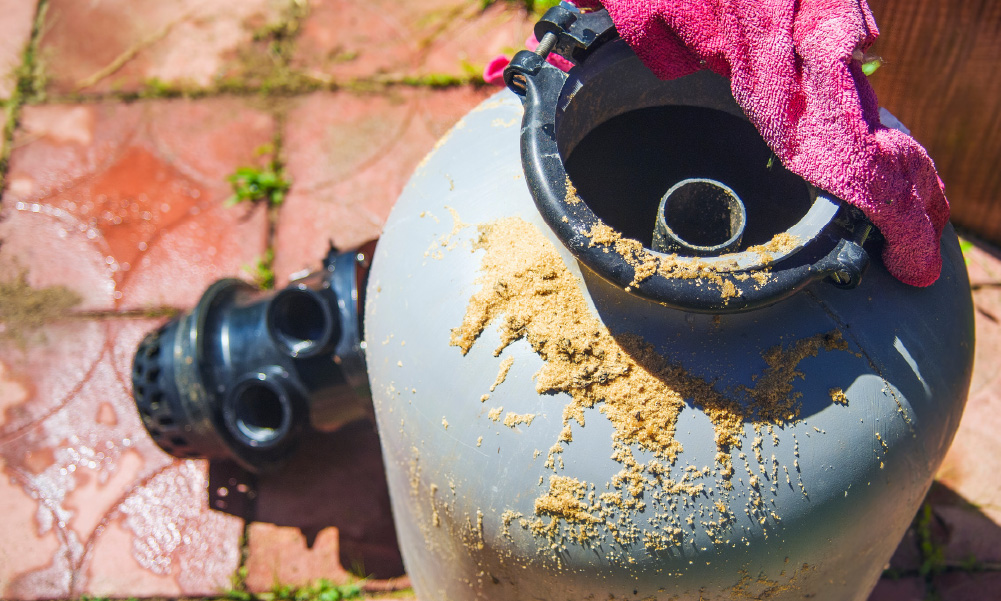
Sand filters are one of the most traditional and widely used pool filter options. They work by pushing water through a bed of specially graded sand. As the water moves through the sand, dirt and debris are trapped, while clean water is returned to the pool.
Sand filters are known for being durable, reliable and easy to operate. They are often chosen by pool owners who want a dependable system that does not require too much day-to-day attention.
When the pressure inside the filter rises, it usually means the filter media has collected enough debris and needs to be cleaned. This is done through backwashing, where water is flushed backwards through the system to remove trapped particles.
Benefits of Sand Pool Filters
- Simple, proven and widely used
- Generally affordable compared to some other filter types
- Suitable for many medium to large pools
- Easy to maintain through backwashing
- Sand media can last several years before needing replacement
- Good option for pool owners who want a low-effort system
Things to Consider
The main drawback of sand filters is that they may not capture the finest particles as effectively as cartridge, glass media or DE filters. This means the water may not look quite as polished or crystal-clear compared with higher-performance filtration systems.
Sand filters also require backwashing, which uses water. If water saving is a priority for you, this is something to consider when comparing filter options.
Over time, the sand inside the filter will also need replacing. The exact timing depends on the system, pool use and maintenance, but many sand filter media types may last several years before replacement is needed.
Glass Media Pool Filters
Glass media filters are a modern upgrade to traditional sand filters. Instead of sand, they use crushed recycled glass as the filtration medium. This material is designed to trap particles effectively while reducing some of the issues associated with traditional sand.
Glass media can provide better water clarity than standard sand because it is able to capture finer particles. It can also be more resistant to clumping and may help reduce bacterial build-up inside the filter.
Because glass media filters often do not need to be backwashed as frequently as sand filters, they may use less water over time and reduce maintenance effort.
Benefits of Glass Media Pool Filters
- Can provide clearer water than traditional sand filters
- Uses recycled glass media
- May require less frequent backwashing than sand
- Can last longer than traditional sand media
- Good balance between performance, efficiency and maintenance
- Suitable for pool owners upgrading from a sand filter
Things to Consider
Glass media filters usually cost more upfront than traditional sand filters. However, the longer lifespan of the media and potential water savings may make them a worthwhile investment over time.
If you want the simplicity of a media filter but better performance than standard sand, glass media can be a strong middle-ground option.
Diatomaceous Earth (DE) Pool Filters
Diatomaceous earth, often called DE, is a very fine powder made from fossilised microscopic algae. In a DE pool filter, the powder coats internal grids and creates a fine filtration surface that captures very small particles from the pool water.
DE filters are often chosen by pool owners who want the clearest water possible. They can deliver excellent clarity and help the water look sparkling and smooth.
Because DE filters can capture very fine debris, they are a strong option for pool owners who are particular about water clarity or who want a high-performance filtration system.
Benefits of DE Pool Filters
- Excellent filtration performance
- Can capture very fine particles
- Helps produce very clear, sparkling pool water
- Suitable for pool owners who prioritise water clarity
- Filter media can be replaced when needed
Things to Consider
DE filters usually require more hands-on maintenance than cartridge, sand or glass media filters. After backwashing, fresh DE powder often needs to be added so the filter can continue working properly.
The powder should also be handled carefully. It is a fine substance, so it is best managed with the right protective equipment and according to manufacturer instructions. Avoid inhaling DE powder and keep it away from children and pets.
DE filter grids may also require deeper cleaning or replacement over time. For some pool owners, the extra maintenance is worth it for the improved clarity. For others, a cartridge or glass media filter may be more practical.
Combination Pool Filters
Combination pool filters use more than one filtration method to help capture different types and sizes of debris. For example, a system may combine cartridge filtration with media filtration to target both larger debris and finer particles.
These systems are designed to improve overall water clarity while reducing the amount of effort needed to keep the pool clean. They can be especially useful for pools that see heavy use, such as family pools, pools used by children every day in summer, or pools used for regular entertaining.
Benefits of Combination Pool Filters
- Strong overall filtration performance
- Useful for heavily used pools
- Can help capture both larger debris and finer particles
- May reduce the amount of manual cleaning needed
- Can support better long-term water quality
- Good option for busy households that want convenience
Things to Consider
Combination systems can cost more upfront than a single standard filter. They may also need more careful setup to make sure the system suits the pool size, plumbing and equipment layout.
However, for pool owners who want convenience and consistently clear water, the investment can be worthwhile.
Which Pool Filter Is Best for You?
The best pool filter depends on your priorities. There is no one-size-fits-all answer, but the guide below can help you narrow down your options.
| Your Priority | Best Filter Option to Consider | Why |
|---|---|---|
| Simple maintenance | Cartridge filter | Easy to clean and does not require backwashing. |
| Lower upfront cost | Sand filter | Traditional, affordable and widely used. |
| Better water clarity than sand | Glass media filter | Captures finer particles and may reduce the amount of backwashing required. |
| Clearest possible water | DE filter | Provides very fine filtration for a high level of water clarity. |
| Heavy pool use | Combination filter system | Can handle a mix of larger debris and finer particles when correctly matched to the pool. |
| Water-saving maintenance | Cartridge or glass media filter | Cartridge filters do not need backwashing, while glass media filters may reduce backwashing frequency. |
| Large family pool | Sand, glass media or combination system | These options can work well for larger pools when the system is correctly sized and installed. |
So, What Filter Should You Use?
If you want a compact, easy-to-clean and water-saving option, a cartridge filter may be the right fit.
If you want a durable and affordable system that is easy to understand, a sand filter is a reliable choice.
If you like the simplicity of a sand filter but want better clarity and efficiency, glass media may be a smart upgrade.
If your priority is the clearest possible water and you do not mind more maintenance, a DE filter may be worth considering.
If your pool gets heavy use and you want strong all-round filtration, a combination filter system may be the best option.
The right filter is the key to keeping your fibreglass pool looking beautiful and feeling safe. Cartridge, sand, glass media, DE and combination filters all offer different benefits, and the best choice depends on your pool, lifestyle and maintenance preferences.
At The Fibreglass Pool Company, we have been helping Australians enjoy clean, sparkling pools for over 30 years. Our team can explain each option in detail and guide you towards a filter setup that suits your lifestyle, budget and backyard.
If you are planning a new fibreglass pool or want advice on the best pool equipment for your home, contact The Fibreglass Pool Company today. For an obligation-free quote, you can also get started through our free quote form.
Frequently Asked Questions
What is the best filter for a fibreglass pool?
The best filter for a fibreglass pool depends on your pool size, usage, budget and maintenance preferences. Cartridge filters are simple and water-saving, sand filters are durable and affordable, glass media filters offer improved clarity, DE filters provide very fine filtration, and combination systems can suit heavily used pools.
Are cartridge filters better than sand filters?
Cartridge filters can provide better water clarity than traditional sand filters and do not require backwashing, which helps save water. However, sand filters are often more affordable, durable and suitable for many medium to large pools. The better option depends on how much maintenance you want to do and how clear you want the water to be.
What is the easiest pool filter to maintain?
Sand filters are often considered easy to maintain because they are cleaned through backwashing. Cartridge filters are also straightforward because you simply remove and rinse the cartridge, although this needs to be done regularly. For many pool owners, cartridge and sand filters are the simplest options.
Do DE filters give the clearest pool water?
Yes, DE filters are generally known for providing very fine filtration and excellent water clarity. They can capture very small particles, which helps create sparkling pool water. However, they require more maintenance and careful handling of DE powder.
Is glass media better than sand in a pool filter?
Glass media can be better than sand if you want improved filtration, clearer water and potentially less frequent backwashing. It usually costs more upfront, but it can last longer and may be more efficient over time.
How often should pool filter media be replaced?
This depends on the filter type, pool usage and manufacturer recommendations. Sand media may last several years, cartridge elements usually need periodic replacement, glass media can often last longer than sand, and DE grids may need deep cleaning or replacement over time. Regular inspections help you know when the filter media is no longer working effectively.